Riding a motorcycle, waging war through art: two metaphors for thinking about Aikidō
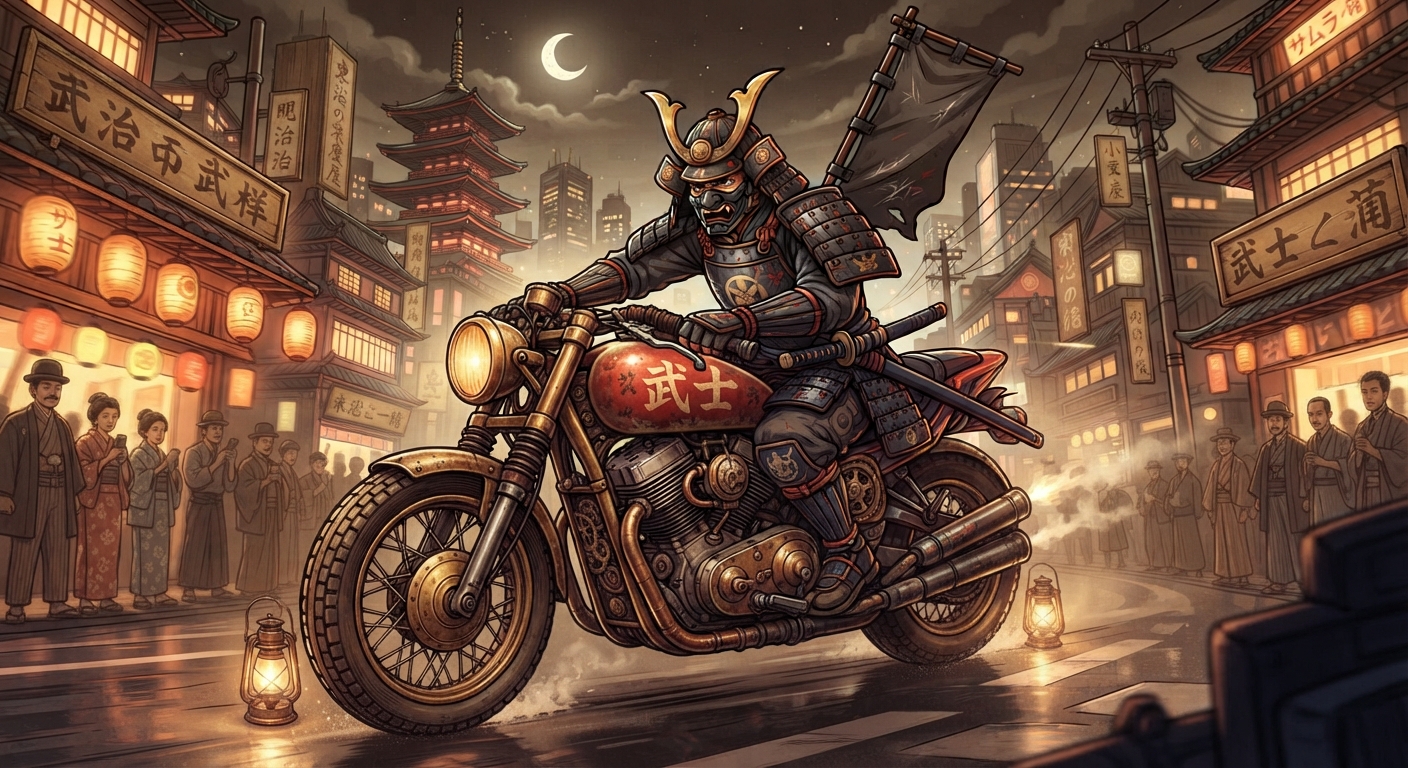
I sometimes compare Aikidō to riding a motorcycle, for three practical reasons that are worth considering separately before bringing them together. The first concerns rules: the highway code sets out the conditions for safe riding — right of way, speed, distance, visibility and responsibility — and, before I act, I must check my attention, position and movement. The second concerns accidents: even when you have not caused an accident, you may still suffer its consequences; being technically “in the right” does not protect you from injury. The third concerns attitude: a car provides considerable physical protection, whereas a motorcycle provides much less. Attention, anticipation, positioning and the ability to make decisions therefore become essential. In short, riding well means avoiding your own mistakes while also anticipating those others might make. It is an almost everyday comparison, yet it leads straight to a less modest question: why not simply call Aikidō a martial art?
The expression is convenient, widely used and immediately understood, especially when martial arts are placed alongside combat sports. I prefer not to rely on it, because in ordinary usage it risks obscuring the harsher reality contained in the idea of war: unpredictability, risk, responsibility and confrontation with another human being. Unlike sport, war also raises a moral question: what happens to our attitude when we face danger, violence, uncertainty and the possibility of injuring someone else? That is why, as a metaphor, I prefer the French expression “Guerre par Art,” or, more precisely, “Guerre travaillée par l’Art”: war shaped by art. It is important to say at once what “art” means here, lest the word slip back into the very ambiguity we hoped to avoid. It means neither decoration nor abstract theory, but action worked through method, strategy, tactics, discipline and practice — a way of acting deliberately refined and developed.
This leads to a very concrete teaching question that every martial arts teacher must sooner or later address: which comes first, the technical action or the attitude that governs it? For me, the answer is attitude — and, in a stronger sense, moral conduct. Technical competence develops within that framework, not before it.
This is where Sunzi enters the discussion. The first chapter of The Art of War, 始計 Shǐ jì, is rendered by Lionel Giles as “Laying Plans.” Sunzi begins by examining a series of factors before any action is undertaken. The first is 道 dào, the Way, which Giles translates as “The Moral Law.” Tao/Do (道), the Way, may also carry other meanings — alignment, moral cohesion, right intention — and other translations are, of course, possible. Giles’s choice remains interesting precisely because it creates a tension: in our culture, positive moral values and war do not readily go together. Perhaps it is in that gap that room for thought opens up.
At the beginning of the chapter, Sunzi places 道 dào before four other factors: 天, Heaven; 地, Earth; 將, command or the general; and 法, method, organization and discipline. Later, comparing the opposing sides, he asks: 主孰有道 — “Which ruler possesses the Way?” The question comes before technique and before battle: what is the orientation, condition and conduct of the person about to act?
The following passages are drawn from ctext.org and concern the opening of the first chapter in Lionel Giles’s translation. “Sunzi said: the art of war is of vital importance to the state. It is a matter of life and death, a path leading either to safety or to ruin. It must therefore never be neglected as a subject of study” — 孫子曰:兵者,國之大事,死生之地,存亡之道,不可不察也。 Then come the five constant factors: “The art of war is governed by five constant factors [...]. They are: (1) the Moral Law; (2) Heaven; (3) Earth; (4) the Commander; and (5) Method and discipline” — 一曰道,二曰天,三曰地,四曰將,五曰法。 Next comes the definition of the first: “The Moral Law brings the people into full agreement with their ruler, so that they follow him even at risk to their lives, undaunted by danger” — 道者,令民與上同意也,可與之死,可與之生,而不畏危。 Finally, the criterion for comparing the opposing sides: “Which of the two rulers is more fully guided by the Moral Law?” — 主孰有道。
Thus, after a journey through a highway code and a treatise some two thousand five hundred years old, we return to the question with which we set off on a motorcycle: what comes first? A good rider does more than obey road signs: above all, they keep themselves in check. Likewise, someone practicing a martial art — or a war shaped by art, to stay with the metaphor — does more than execute a technique: they first examine the attitude with which they execute it. This subject is not unfamiliar to this blog. Readers who have already seen the discussion here of the conceptual metaphors through which the international aikido community describes itself, and of the paradox of harmony and war within them, will find the same question approached from another angle: the philology of an ideogram.
A. Pelos
Sources: Sunzi, The Art of War, chapter I, Lionel Giles translation (1910); Chinese passages and Giles’s translation at ctext.org. The English quotations above translate the wording of the Italian text.
Leave a Reply