The Metaphors of Aikidō: From Representing the Art to Training the Practitioner
The metaphors through which aikidō (合気道) is described are not simply different ways of describing the same practice. Each metaphor selects certain aspects of the experience, makes some of them visible and leaves others in the background. Above all, it shapes the way the teacher interprets what must be transmitted and the way the practitioner interprets what must be learned.
This is why the question of how we describe aikidō is not merely a matter of language. Different representations of aikidō can lead to different forms of teaching, different training exercises and, ultimately, different ideas of what an experienced practitioner should be able to do.
Throughout the history of aikidō, different representations have become established. Among those that have had the greatest influence, we can identify:
- aikidō as love
- aikidō as harmony
- aikidō as union
- aikidō as relationship
- aikidō as a martial art
- aikidō as “war with art”
- aikidō as driving a vehicle
These metaphors do not have the same pedagogical value. Some primarily describe a moral orientation; others place the relationship at the center; still others preserve the reference to the martial dimension. The vehicle metaphor, by contrast, introduces a properly formative structure: there is a set of rules that must be known, a technical ability that must be acquired, an ability to read the situation that must be developed and, finally, a responsibility that accompanies autonomy.
The difference becomes particularly evident when we observe what happens on the tatami. If aikidō is conceived as a relationship, for example, the exercise will tend to prioritize the quality of the encounter between tori (取り) and aite (相手). If it is conceived as a martial art, attention may shift toward technical ability and the effectiveness of the action. If, instead, it is interpreted as “war with art,” the problem becomes more radical: one must learn to read a situation in motion and recognize the moment when its course can be changed.
The metaphor we choose therefore influences what we consider important in Aikido teaching. It can affect what the teacher demonstrates, what the student practices and what counts as progress.
Aikidō as Love
The metaphor of love places aikidō within a predominantly ethical representation. The encounter with the other is interpreted as an opportunity for openness, acceptance and mutual transformation. Aggressiveness tends to be brought within a relationship in which the other is not regarded simply as an obstacle to be eliminated.
This representation has its own pedagogical strength. It makes it possible to remove the practice from the simple logic of overpowering and gives the martial action a meaning that goes beyond victory over the opponent. However, precisely because it focuses attention on the moral quality of the relationship, it risks leaving the question of concrete effectiveness undefined.
A practitioner can, in fact, learn to regard the other positively without thereby acquiring the ability to act when the situation becomes genuinely difficult. They can develop openness, respect and cooperation without necessarily being able to recognize a threat, withstand pressure or intervene at the moment when the situation is changing.
The metaphor of love therefore produces an ethical orientation, but by itself it does not determine a curriculum for effectiveness.
Aikidō as Harmony
The metaphor of harmony has achieved an even wider diffusion. It presents action as the search for an arrangement in which the forces involved can find a form of agreement.
On the tatami, this representation can translate into the search for fluid movements, the reduction of muscular opposition, continuity of action and the ability to adapt to the movement of the other.
The pedagogical problem arises when harmony is transformed from a quality sought in execution into a general premise of action. In a genuinely conflictual situation, in fact, the relationship is not necessarily harmonious. The other person may resist, accelerate, change direction, interrupt the expected action or exploit a mistake.
The decisive question then becomes the ability to act within a situation that does not present the ideal conditions of the exercise.
In this sense, the metaphor of harmony can effectively describe a quality of movement, but it becomes insufficient when it has to explain how the practitioner can continue to act when the expected balance is lost.
For Aikido pedagogythis distinction matters because an exercise designed around harmonious movement may teach one set of abilities, while an exercise designed around unpredictable resistance may develop another.
Aikidō as Union
The metaphor of union draws attention to the composition of forces. The movement of tori (取り) and that of aite (相手) are regarded as elements destined to enter into a common configuration.
This image, too, has an evident teaching function. The beginner is gradually taught not to perceive their own body as separate from that of the partner. They learn to sense contact, direction, weight, rhythm and the other person's variations.
But union does not necessarily coincide with the ability to manage a situation. Two bodies can move together without the practitioner being able to recognize when the other is about to break that configuration. Practice can therefore produce a good quality of shared movement without developing to the same extent the ability to intervene when the situation deviates from the expected form.
The difference is subtle but decisive: union concerns the configuration of the relationship; effectiveness concerns the ability to act within the transformation of that configuration.
This distinction is particularly relevant when considering how Aikido techniquesare taught. A shared movement can be reproduced correctly while the underlying capacity to respond to an unexpected change remains undeveloped.
Aikidō as Relationship
The metaphor of relationship further broadens the field. The center of learning is no longer only individual movement, but what happens between practitioners.
This approach makes it possible to understand why aikidō cannot be reduced to learning a motor sequence. The gesture acquires meaning through the behavior of the other. Distance, maai (間合い), contact, pressure, rhythm and direction acquire value only within an interactive situation.
Relationship therefore introduces a fundamental element: uncertainty.
If the other person's behavior is always kept within a predetermined form, the relationship remains strongly controlled. The practitioner can learn to respond to certain pieces of information without being required to decide when that information changes.
This is where the pedagogy of relationship must meet the pedagogy of effectiveness. The partner must not merely enable the execution of the form; they must also be capable of modifying the situation enough to force tori (取り) to perceive, decide and act.
The quality of the relationship therefore becomes pedagogically significant not only because practitioners interact, but because interaction creates the conditions under which perception, decision-making and action can be learned.
Aikidō as a Martial Art
The metaphor of the martial art explicitly preserves the reference to the dimension of combat. It raises the question of the ability to act in a situation in which there is a conflict of interests, a threat or a concrete possibility of being overpowered.
The term “art,” however, can be understood in different ways.
If the martial art is identified with a repertoire of techniques, teaching tends to focus on the correct execution of waza (わざ). The practitioner must learn specific forms and acquire precision, speed, stability and the ability to apply them.
But the technical repertoire does not exhaust martial competence. A technique may be perfectly known and yet prove unusable when the situation does not assume the expected configuration. The distance may be different, the attack may arrive with unexpected timing, aite may change intention, or several people may be present.
The pedagogical question therefore shifts from the availability of the technique to the ability to use it within a process that cannot be entirely controlled.
This is one of the central problems in Aikido martial arts training: knowing a waza (わざ) is not necessarily the same as being capable of acting when the conditions under which it was learned have changed.
Aikidō as “War with Art”
The metaphor of “war with art” introduces a substantial difference from the traditional expression “the art of war.”
The expression “the art of war” tends to evoke a specific body of knowledge concerning combat, strategy and victory. “War with art,” instead, shifts the emphasis toward the way in which a conflictual situation is traversed and transformed.
From this perspective, art consists in the ability to recognize, within a process already underway, the moment when the situation can change direction. The practitioner does not necessarily possess enough strength to impose the desired outcome from the outside. Rather, they must identify what, within the situation itself, makes a transformation possible.
This is one of the central aspects of François Jullien’s reflection on Chinese strategy. In Chinese strategic texts, effectiveness is not conceived primarily as the application of a predetermined model, but as the ability to grasp the potential contained within the situation and accompany its transformation. The process carries within itself a certain propensity, and effective action consists in recognizing and making use of it.[^1]
Transposed onto the tatami, this perspective profoundly changes the meaning of learning. Tori (取り) must not merely know a response to a particular attack. They must learn to observe what is happening, recognize where the situation is becoming favorable, identify the moment when the configuration can tip and intervene before that possibility disappears.
The decisive point therefore does not necessarily coincide with the beginning of the action. It may lie in the course of the action itself, when the balance of possibilities is changing.
This reading also makes it possible to understand why “war with art” is a particularly appropriate metaphor for a practice in which disparity of strength constitutes a structural condition. The weaker person cannot base their effectiveness simply on producing greater force. They must be able to recognize what in the situation makes it possible to transform the balance of forces.
Strategy thus becomes a perceptual, temporal and decision-making competence even before it becomes a repertoire of solutions.
Training must therefore produce situations in which the practitioner is forced to recognize the favorable moment, rather than merely reproduce an already-known response. Variability in the attack, pressure from aite (相手), the presence of multiple people, the use of weapons, fatigue and the possibility of error become teaching elements because they continuously modify the process.
From this perspective, weakness also takes on a particular meaning. It is not simply a condition to be compensated for through greater technical skill. It can become the starting point for a different way of reading the situation. The need to survive a superior force in fact compels one to search for a margin, a discontinuity, a possible transformation.[^2]
The metaphor of “war with art” therefore takes martiality beyond the simple dimension of combat technique. It places it in the ability to remain within a conflictual situation without expecting it to remain stable, and to recognize the moment when the course of the forces can be changed.
Aikidō as Driving a Vehicle
The metaphor of the vehicle introduces another way of understanding learning. In this case, the practitioner is not conceived merely as someone who must acquire a series of movements, but as a person who must learn to use an ability within a shared space, subject to rules and characterized by the presence of other people.
The sequence of learning is significant.
Before driving a vehicle, one must know the rules of the road. Subsequently, one learns the controls of the vehicle and the skills necessary to operate it. Only after acquiring these abilities does it become possible to deal with variable situations, interpret the behavior of other road users and make autonomous decisions.
Autonomy, however, does not mean freedom from rules. On the contrary, competence consists in the ability to act autonomously precisely because the rules have been incorporated and can guide action even when the teacher is no longer present.
The vehicle metaphor thus makes it possible to introduce into the pedagogy of aikidō a normative dimension that often remains implicit. Ethics is not added at the end of the process as a comment on the meaning of the practice. It is present from the beginning in the conditions that make it possible to practice together.
The beginner must learn how to enter the tatami, how to move through the space, how to treat the partner, how to control their own actions, how to fall and how to allow the other person to practice without unnecessarily exposing them to risk. These rules constitute a kind of code of practice.
Only within this framework can autonomy gradually develop.
The vehicle metaphor therefore makes it possible to interpret the teaching process according to a sequence in which competencies are built without being separated from responsibility:
rules precede technique; technique precedes strategy; strategy precedes autonomy; autonomy precedes teaching.
The parallel with aikidō becomes particularly interesting when considering the advanced stage. An experienced driver does not mechanically follow a sequence of commands. Their competence manifests itself in the ability to perceive simultaneously the road, other vehicles, speed, environmental conditions and possible changes in the situation.
Similarly, an experienced practitioner should not depend on the presence of a perfectly recognizable form. They must be able to act when the situation changes, while simultaneously maintaining respect for the conditions that make practice possible.
The vehicle metaphor therefore introduces a conception of competence in which technique, strategy and responsibility are not separate elements. Technique makes action possible; reading the situation guides its use; rules delimit its use; responsibility ultimately allows the practitioner to act without requiring continuous supervision.
This metaphor also reveals the limitation of a teaching approach that stops at the transmission of waza (わざ). Knowing how to perform an action is, from this perspective, equivalent to knowing the controls of a vehicle. It does not yet mean knowing how to drive.
Driving means using those controls within a dynamic environment shared with others and governed by constraints. In the same way, practicing aikidō means bringing what has been learned through technique into situations in which the other person can continuously modify the process.
The metaphor of driving a vehicle finally makes it possible to understand the relationship between autonomy and responsibility. The mature practitioner is not the person who can finally do whatever they want. They are the person who can make decisions without losing sight of the conditions that make their own and others' actions possible.
In this sense, the vehicle metaphor completes that of “war with art.” The latter highlights the ability to read and transform a situation; the former shows the normative and formative conditions necessary for this ability to be exercised responsibly.
The former concerns above all how to remain within a conflictual process; the latter concerns the path through which a person becomes capable of autonomously assuming responsibility for their own actions.
Metaphors and Forms of Aikido Pedagogy
The seven metaphors do not simply produce seven ways of talking about aikidō. They produce different teaching practices.
The metaphor of love directs attention toward the moral formation of the relationship. That of harmony prioritizes the quality of shared movement. Union focuses attention on the composition of forces. Relationship introduces interdependence and uncertainty. The martial art keeps the reference to effectiveness in conflict open. “War with art” draws attention to the process, to the propensity of the situation and to the moment when the balance of forces can change. Driving a vehicle adds the formative progression that leads from knowledge of the rules to responsibility for autonomous action.
The choice of metaphor therefore becomes a pedagogical choice.
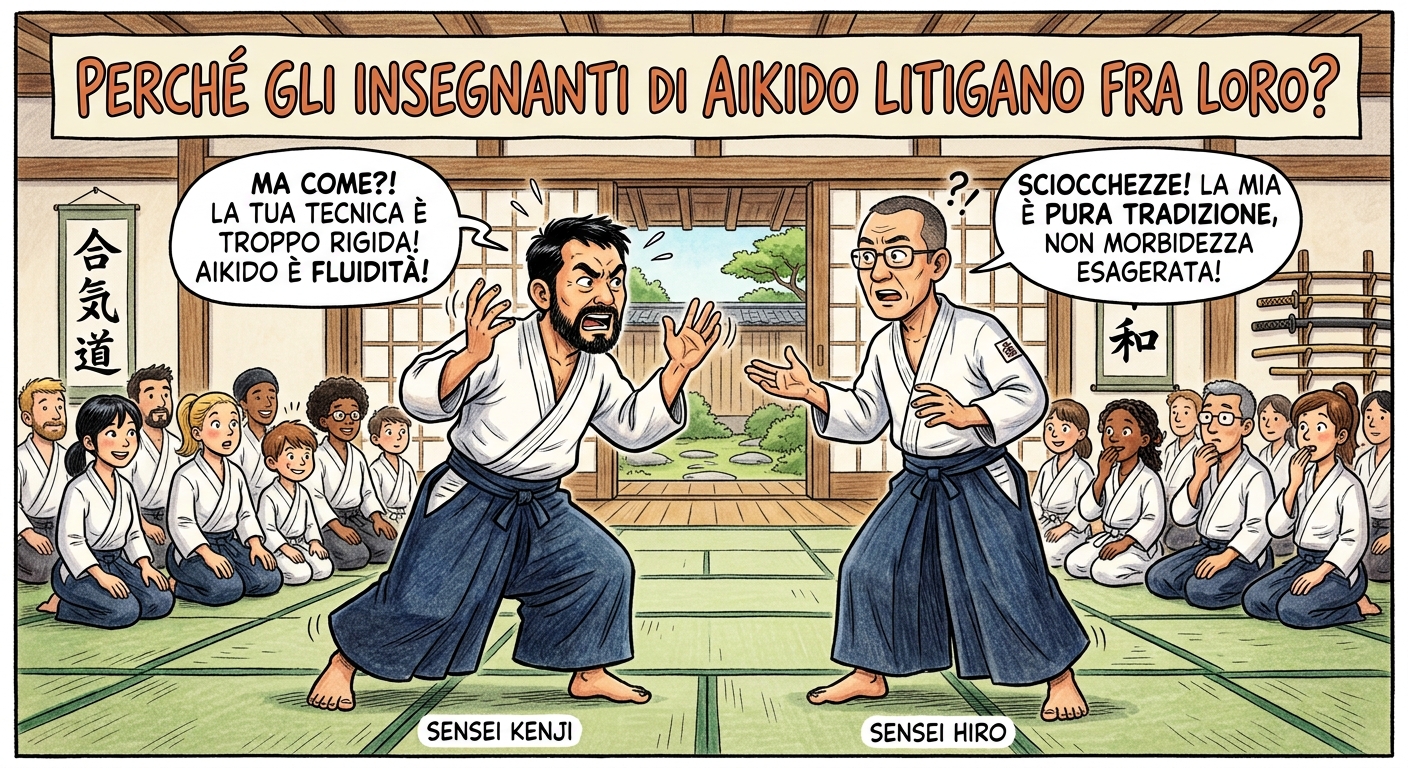
This may also help explain why Aikido teachers can disagree so strongly about what should be taught. If teachers begin from different underlying metaphors, they may evaluate the same exercise, the same technique or the same practitioner according to completely different criteria.
A teacher who considers aikidō primarily as a relationship will probably construct exercises in which the quality of the encounter plays a central role. A teacher who considers it primarily as a martial art will tend to question technical ability and effectiveness. A teacher who adopts the perspective of “war with art,” on the other hand, will have to construct situations in which the practitioner is forced to recognize the changing process and intervene at the appropriate moment.
These differences are not necessarily the result of personal disagreements. They can arise from different conceptions of what Aikido training is supposed to accomplish.
The vehicle metaphor introduces a further question: what must a practitioner be capable of doing autonomously when the teacher is no longer standing in front of them?
It is this question that transforms practice from the simple transmission of forms into a process of competence development.
Ultimately, the way an instructor understands aikidō determines not only how the art is explained, but also what kind of practitioner the teaching process is designed to produce.
[^1]: François Jullien, Pensare l’efficacia in Cina e in Occidente, translated by Massimiliano Guareschi, Rome-Bari, Laterza, 2006. In particular, the sections devoted to the notion of the “potential of the situation,” the process and the reflection on opportunity. The Italian edition was published by Laterza in the “I Robinson. Letture” series. Pensare l’efficacia in Cina e in Occidente, traduzione di Massimiliano Guareschi, Roma-Bari, Laterza, 2006. In particolare, le sezioni dedicate alla nozione di «potenziale della situazione», al processo e alla riflessione sull’occasione. L’edizione italiana è pubblicata da Laterza nella collana «I Robinson. Letture».
[^2]: François Jullien, Pensare l’efficacia in Cina e in Occidente, op. cit., section “Cercare un margine per sopravvivere (anziché sacrificarsi).”
Leave a Reply